
The Flats of Beverly Hills
Local Guide
The Flats of Beverly Hills is one of the most beautiful and exclusive neighborhoods in Los Angeles. The housing stock is only single-family luxury homes and estates, priced way higher than the Los Angeles County average. Every street is different, and the trees are beautiful. You’ll find classic homes on big lots, and pools and tennis courts are common on some of the larger properties.
If you’ve ever spent time in The Flats of Beverly Hills, you understand there’s something special about it—something you can feel the moment you arrive. I grew up here, and over the years, I’ve watched the neighborhood evolve, but the core of what makes it special hasn’t changed. The Flats has always been the heart of Beverly Hills living.
Quick Snapshot of The Flats
- Location: North of Santa Monica Blvd., Doheny to Whittier
- Lot sizes: 11,000–15,000 sq. ft. average; 25,000–30,000 sq ft in northern sections
- Architecture: Georgian, Spanish Revival, Mid-Century Modern, Contemporary
- Walkability: Excellent—walk to town for breakfast, shopping, and parks
- Character: Wide, flat streets with mature trees and classic architecture
WHAT DEFINES THE FLATS?
The Flats of Beverly Hills is the area north of Santa Monica Blvd., south of Sunset Blvd., stretching from Doheny Drive to Whittier Drive. Living in the Flats of Beverly Hills means experiencing one of Los Angeles’ most walkable, elegant neighborhoods—a neighborhood that combines estate-scale living with urban convenience, a balance that’s increasingly rare in Southern California.
Where it sits
The Flats occupies the area north of Santa Monica Blvd. and south of Sunset Blvd., stretching from Doheny Drive to Whittier Drive. This central location puts residents minutes from the Beverly Hills Hotel and the Golden Triangle shopping district.
The neighborhood naturally divides into three sections: the East Flats towards Doheny Drive, the Center Flats along Beverly Drive and Canon Drive, and the West Flats extending towards Walden Drive. Each area has its own character, but all share the same walkable streets and mature landscaping that define the neighborhood. From the West Flats, Roxbury Park is an easy walk, while the Center and East sections provide quick access to the Golden Triangle. You can walk into town for breakfast or shopping, visit a friend’s house, or simply enjoy the tree-lined streets.
The streetscape
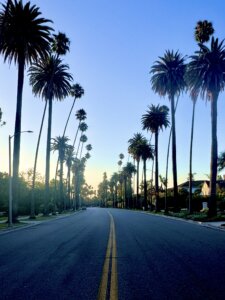
What makes The Flats instantly recognizable is its layout: flat, wide streets bordered by mature landscaping and generously set-back homes. Beverly Drive is famous for its towering palm trees that create that iconic Southern California feel, while Maple Drive lives up to its name with its canopy of maples that turn brilliant colors in the fall.
The streets are designed for living, not just driving. You’ll see residents walking dogs, kids on bikes, neighbors stopping to talk on the sidewalk, and joggers enjoying the flat terrain. It’s a neighborhood that supports daily life without drawing attention to itself—an understated confidence that defines Beverly Hills character.
The residents
From the 1950s through the 1980s, The Flats attracted entertainment industry professionals—producers, studio executives, and directors who wanted to live close to the action while maintaining residential privacy. The neighborhood also drew corporate executives, business leaders, physicians, and entrepreneurs.
What people sometimes forget is that the magic wasn’t just in the houses or the palm-lined streets—it was in the people. They valued what residents still value today: great schools, walkability, safety, and community. Those fundamentals, supported by excellent police and fire departments, created a level of comfort and confidence that set Beverly Hills apart.
REAL ESTATE IN THE FLATS OF BEVERLY HILLS
One of The Flats’ defining features is the scale of its properties. The neighborhood offers lot sizes that create both privacy and presence—wide frontages, long driveways, and deep lots that are increasingly rare in Los Angeles.
Lot sizes by location:
500 blocks: Average 11,000 to 15,000 square feet, with notable exceptions. On Beverly Drive and Crescent Drive, some properties are unusually deep—stretching up to 200 or even 250 feet. That can put those lots close to 25,000 square feet, which is substantial by Beverly Hills standards.
700 and 800 blocks: Lots typically range from 25,000 to 30,000 square feet as you move north toward Sunset Blvd., This northern area offers some of the largest residential parcels in the neighborhood.
This mix of lot depth and width gives The Flats its distinctive character and contributes to the open, elegant look that defines the area. Even where homes have been rebuilt or expanded, the generous setbacks and mature landscaping maintain the neighborhood’s sense of space.
ARCHITECTURAL HIGHLIGHTS AND DESIGN EVOLUTION
The Flats showcases nearly a century of architectural evolution, with homes that reflect both heritage and contemporary design.
Historic foundations
Much of The Flats was developed during the 1920s and 1930s, when Beverly Hills began attracting studio executives, silent film stars, and business leaders. Classic Georgian and Spanish Revival homes from this era remain remarkably intact, offering architectural continuity in a city known for reinvention.
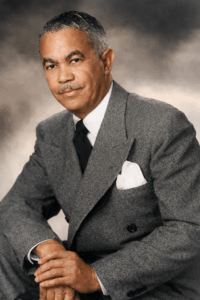
Some of the most beautiful homes here were designed by architect Paul R. Williams, one of the most influential architects in Beverly Hills history. His work gave the Flats much of its signature style—graceful lines, timeless proportions, and a refined balance that still defines the area today.
Architectural variety
You’ll find everything from classic Georgian and Spanish Revival homes to Mid-Century Modern designs and new contemporary builds. Spanish Colonial features like stucco walls, red-tile roofs, and wrought-iron details coexist with Tudor Revival homes showcasing half-timber framing and leaded glass. Modern construction emphasizes floor-to-ceiling glass, open layouts, and seamless indoor-outdoor living.
Notable landmarks
One of the most recognizable homes in the neighborhood is the Witch’s House, officially known as the Spadena House, located on the corner of Walden Drive and Carmelita Avenue. Built in the 1920s and later moved to Beverly Hills, it’s become a local landmark—whimsical, distinctive, and a reminder that this neighborhood has always valued individuality and creativity alongside elegance and design.
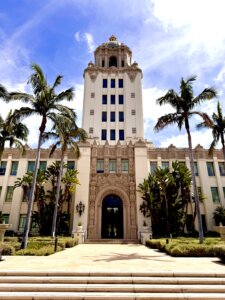
Just blocks away, Beverly Hills City Hall stands as another architectural icon. Completed in 1932 in the Spanish Renaissance style, the building features a distinctive dome topped with a tile cupola that’s visible throughout the neighborhood. The City Hall anchors the Civic Center and represents the city’s commitment to architectural excellence and civic pride—values that have shaped.
The Flats since its earliest days.
LIVING IN THE FLATS OF BEVERLY HILLS TODAY
Living in the Flats of Beverly Hills today means experiencing the same balance that attracted families decades ago. The neighborhood hasn’t lost its character, even as homes have been renovated, the market has appreciated, and design trends have evolved.
Walkability and daily life
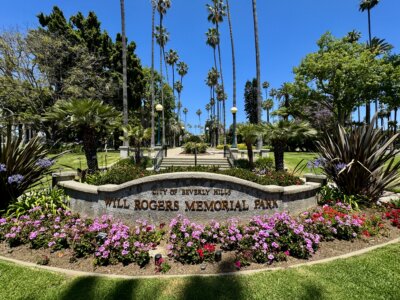
The Flats is unusually convenient for a luxury neighborhood. Sidewalk-lined streets make it easy to enjoy a morning walk or bike ride through tree-shaded avenues. The flat terrain and grid layout mean you can walk to Roxbury Park, Will Rogers Memorial Park just south of Sunset Blvd., local cafés, or Beverly Hills shops without getting in the car. Morning walks along the Santa Monica Blvd., parkway are especially popular, offering a peaceful tree-lined path that connects the neighborhood to the city’s amenities.
Just blocks away, residents have access to Pavilions on Santa Monica Blvd., boutique fitness studios, and essential services. For families, Roxbury Park offers tennis courts, sports fields, and playground space ideal for weekend activities
Schools and community
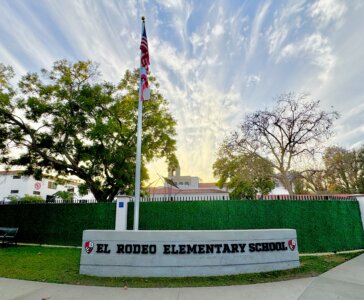
The Flats is part of the Beverly Hills Unified School District, which includes highly regarded public schools. The combination of strong schools, neighborhood walkability, and community connection continues to draw families who want stability and quality of life.
Dining and retail access
The Golden Triangle—Beverly Hills’ premier shopping and dining district—is minutes away. Rodeo Drive, Canon Drive, and Beverly Drive offer everything from world-class retail to neighborhood restaurants. Living in The Flats puts all of this within reach, often without needing to drive.
The rhythm of the neighborhood
Even now, you’ll still see kids on bikes, neighbors walking their dogs, and people stopping to talk on the sidewalk. I take my morning walks between 6:30 and 7:30 am and always get a “good morning” from others out early. Homes have gotten larger, designs have evolved, and the market has reached levels no one imagined decades ago—but the neighborhood’s character remains. That balance between change and continuity is what makes The Flats special.
THE FLATS OF BEVERLY HILLS: A LEGACY NEIGHBORHOOD
That’s what makes living in the Flats of Beverly Hills unique. It’s not just the architecture or the location—it’s the feeling of stability, familiarity, and community that defines Beverly Hills. The Flats continues to represent the best of Beverly Hills living: timeless, beautiful, and built on a foundation of people who truly care about where they live.
The neighborhood rewards thoughtful investment because it offers something increasingly rare: generous lots, architectural integrity, walkable streets, and a lifestyle that balances privacy with community. These fundamentals don’t change, which is why The Flats remains the heart of Beverly Hills.
Written by Marty Halfon, lifelong Beverly Hills resident and real estate professional